Claim Free Cleaning With Leaf Guards
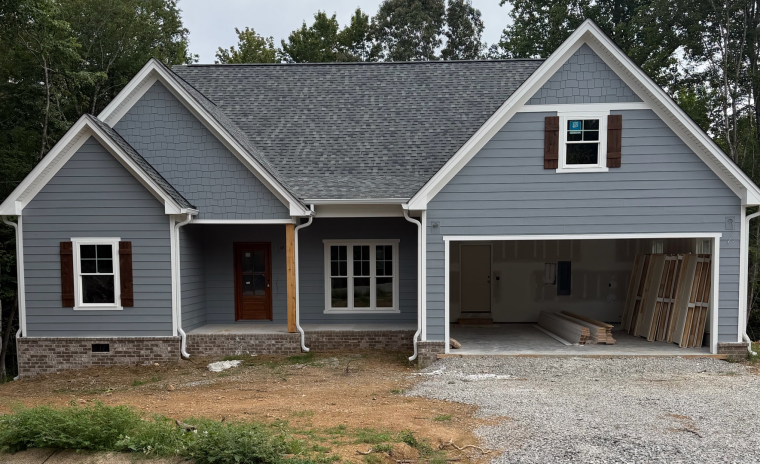
Seamless vs. Sectional Gutters in Chattanooga, TN
Why Fewer Joints Mean Better Storm Protection
The Core Difference
The fundamental distinction between sectional and seamless gutter systems lies in how they’re manufactured and assembled. Sectional gutters arrive at your home in pre-cut segments, typically ten or twenty feet long, designed to be pieced together along your roofline. Each connection point requires a coupling, fasteners, and sealant to hold the system together and prevent water from escaping. On most homes in Hixson and Soddy-Daisy, that translates to anywhere from eight to fifteen joints along the perimeter, each one creating a potential weak point.
Seamless gutters take a fundamentally different approach. Instead of assembling pre-made sections, gutter installers bring a roll-forming machine directly to your property and extrude continuous aluminum channels cut precisely to match each roofline segment. A typical residential installation might have only two or three joints total, located at inside or outside corners where directional changes are unavoidable. The rest of each run is a single piece of formed metal with no interruptions.
This construction difference matters more than it might initially appear. When rain hits your roof during one of Chattanooga’s spring thunderstorms, water doesn’t trickle gently into your gutters. It arrives in surges, sometimes several gallons per minute concentrated along valley lines and roof edges. A sectional system asks that water to flow smoothly across multiple seams, each one creating a slight ridge or gap in the channel’s interior surface. Even when new and properly sealed, these joints disrupt water flow and create turbulence.
Seamless systems eliminate that disruption. Water enters the gutter and flows unobstructed toward the downspouts, following a smooth aluminum channel with consistent pitch and no interior obstacles. For homeowners in downtown Chattanooga dealing with older homes and mature tree canopy, that smoother interior also means fewer places for leaf fragments, seed pods, and sediment to catch and begin forming blockages. The difference becomes particularly apparent during heavy weather, when the system needs to move the highest volume of water in the shortest time.
Why Joints Fail in This Region
East Tennessee’s climate subjects gutter joints to a uniquely challenging combination of stresses that accelerate deterioration in ways homeowners don’t always anticipate. The region experiences significant seasonal temperature swings paired with consistently high humidity, creating conditions that test every sealed joint in a sectional system multiple times each year.
During summer months, temperatures in Hixson regularly climb into the low nineties with humidity levels consistently above seventy percent. Aluminum expands in heat, and when that expansion occurs across a joint sealed with caulk or equipped with a rubber gasket, the connection experiences stress as the two sections try to move slightly relative to one another. The sealant flexes and stretches. Then, when a cold front pushes through in January and overnight temperatures drop into the teens, that same aluminum contracts. The sealant, now aged by months of UV exposure and temperature cycling, must compress and maintain its bond. Each cycle weakens the seal incrementally.
The real damage accelerates during freeze-thaw periods, which Chattanooga sees regularly between December and March. Water that has seeped into even microscopic gaps in a joint expands when it freezes, forcing the gap wider. When temperatures rise above freezing during the day, the ice melts, and more water enters the now-larger gap. The next freeze expands it further. Within a single winter season, a joint that appeared sound in November can develop visible separation by March.
Spring storm season compounds the problem. When a line of thunderstorms rolls off Signal Mountain and drops two inches of rain in ninety minutes, the volume of water moving through your gutters can exceed their design capacity if any portion of the system is compromised. A joint that has developed even a small leak doesn’t just drip. Under pressure from backed-up water, it can separate further or begin directing water behind the fascia board, where it causes rot that won’t be visible until the damage is extensive. The leaf load from fall adds another layer of stress. Oak, maple, and tulip poplar trees dominate the ridges and older neighborhoods throughout the Chattanooga area, and their leaves don’t just sit on top of sectional gutter systems. They wedge into joints, trap moisture against the sealant, and create small dams that force water to find alternative paths, often directly through the weakened seal.
Storm Performance Comparison
When evaluating how sectional and seamless systems actually perform during the weather conditions Chattanooga homeowners face throughout the year, the differences become concrete and measurable. Heavy rain events provide the clearest performance gap. During a typical spring thunderstorm that delivers high-volume rainfall in a short window, a seamless system channels water smoothly from roof edge to downspout without interruption. The continuous interior surface allows water to maintain velocity and exit the system efficiently, even when flow rates spike.
Sectional systems, by contrast, experience turbulence at every joint. Water hits the slight ridge created by the coupling, slows momentarily, and can begin to back up if debris has accumulated or if the joint has shifted slightly out of alignment. Under sustained heavy flow, that backup increases pressure on the joint itself, making separation more likely. Homeowners in Red Bank and East Ridge frequently report that the first visible leak in an aging sectional system appears during a heavy storm, when the system is under maximum stress and any weakness in a seal becomes immediately apparent.
Wind performance follows a similar pattern. Chattanooga storm fronts can produce sustained winds strong enough to lift unsecured materials and test the fastening of any exterior building component. Sectional gutter systems have more connection points, and each connection represents a place where wind-driven forces can find leverage. If a coupling has loosened slightly or if the fasteners at a joint have worked free over time, wind can begin to pry sections apart. Seamless systems, fastened at regular intervals along a continuous length of aluminum, distribute wind loads more evenly and provide fewer opportunities for wind to exploit a weak point.
Debris management is another area where construction method directly impacts performance. Sectional joints create small ledges and overlaps on the interior surface where leaves, shingle grit, and organic material naturally accumulate. Even a small accumulation can begin to trap additional debris and slow water flow, eventually forming a blockage that causes water to overflow or back up under the roof edge. Gutter cleaning becomes more difficult and more critical with sectional systems because these interior obstacles require more thorough attention to clear completely.
Longevity represents perhaps the most significant performance difference. With proper installation and routine maintenance, seamless aluminum gutters can function effectively for twenty years or more in this climate. Sectional systems, subjected to the same conditions, typically begin showing joint failures within ten to fifteen years, requiring repair or replacement significantly sooner. Over the useful life of the system, that difference translates directly into fewer repair calls, less water damage, and lower total cost of ownership.
When Sectional Still Makes Sense
While seamless systems offer clear advantages for primary residences exposed to the full range of Chattanooga’s weather patterns, sectional gutters aren’t inherently flawed products. They serve specific purposes in situations where their limitations matter less than their advantages. Understanding when sectional systems remain a reasonable choice helps homeowners make informed decisions based on their specific circumstances rather than marketing claims.
The most straightforward scenario involves small outbuildings, sheds, and detached garages where the consequences of gutter failure are minimal. If water overflow from a garden shed gutter lands on gravel or a drainage area rather than near a foundation or landscaping, and if the structure itself isn’t climate-controlled or particularly valuable, the lower upfront cost of a sectional system can make practical sense. These installations typically involve short runs with few corners, meaning joint count stays low and installation remains simple enough for a capable homeowner to complete over a weekend.
Short-term or temporary applications represent another appropriate use case. If you’re planning significant renovations within the next few years that will involve replacing or substantially modifying your roofline, installing an expensive seamless system now means paying for longevity you won’t fully utilize. A sectional system can provide adequate protection during the interim period at lower cost, with the understanding that it will be replaced when the larger project moves forward.
Budget constraints sometimes dictate choices, particularly for rental properties or homes being prepared for sale where the owner’s priority is functional adequacy rather than long-term performance. In these situations, sectional gutters can provide basic drainage capability at the lowest possible initial investment. The trade-off is accepted knowingly: more frequent maintenance, shorter lifespan, and higher likelihood of repair needs, balanced against immediate cost savings.
It’s also worth noting that sectional systems can be appropriate for particularly complex rooflines where access limitations make bringing roll-forming equipment on-site impractical. Some historic properties or homes with extremely tight side-yard clearances may present logistical challenges that favor pre-fabricated sections carried to the work area. However, these situations are relatively rare in typical residential settings throughout Hixson, Soddy-Daisy, and the greater Chattanooga area.
The key consideration in every case is matching the system to the application. For primary residences where gutter failure means foundation damage, fascia rot, or compromised landscaping, and where you plan to own the property long enough to benefit from durability, seamless systems represent the better value despite higher upfront cost. For auxiliary structures, temporary needs, or situations where other factors outweigh performance, sectional systems can serve adequately. The mistake comes from treating them as equivalent choices for a primary home’s perimeter gutter installation, where the long-term costs of sectional system failures typically exceed any initial savings within the first decade of ownership.
Custom Installation for Chattanooga Weather
While seamless systems offer clear advantages for primary residences exposed to the full range of Chattanooga’s weather patterns, sectional gutters aren’t inherently flawed products. They serve specific purposes in situations where their limitations matter less than their practical advantages. Understanding these scenarios helps homeowners make informed decisions about where each system type belongs.
Small outbuildings, storage sheds, detached garages, and workshop structures represent the most straightforward applications for sectional gutters. These structures typically feature simpler rooflines with fewer corners and shorter runs, which naturally reduces the number of joints required. A twelve-foot shed might need only two or three gutter sections total, minimizing the cumulative risk that makes sectional systems problematic on larger buildings. The stakes are also different: water damage to a storage shed’s foundation or siding, while undesirable, rarely carries the same consequences as foundation issues on your primary home.
Budget constraints on secondary structures often justify the sectional choice. When you’re protecting a $3,000 shed rather than a $300,000 home, the lower material and installation costs of sectional gutters align better with the structure’s value. The DIY-friendly design also appeals to homeowners comfortable working at moderate heights who want to tackle the project themselves over a weekend, particularly when the building sits on level ground with easy access.
Temporary installations represent another appropriate use case. Property owners managing rental units awaiting renovation, or homeowners planning near-term replacements of older structures, sometimes need a functional gutter system without committing to a premium installation. Sectional gutters can fill that gap acceptably for a defined period. Similarly, historic preservation projects occasionally require matching specific sectional profiles to maintain architectural authenticity, though these situations are relatively rare in residential applications.
The key consideration is exposure level. Structures sheltered by tree cover, tucked into corners of the property with reduced wind exposure, or featuring roof designs that naturally shed water away from foundations can sometimes tolerate sectional systems without the accelerated failure patterns seen on exposed primary residences. Even then, homeowners should expect more frequent maintenance, earlier replacement, and greater vigilance about leak points compared to seamless alternatives.
For primary homes in Hixson, Soddy-Daisy, and throughout the Chattanooga area, where gutter performance directly protects your largest investment against foundation settlement, siding rot, and landscape erosion, sectional systems rarely represent the most sensible long-term choice. The initial savings get consumed by repair calls, water damage mitigation, and premature replacement, shifting costs from installation day to the years that follow.